Our interim arrangements for interlibrary loan seem to be working well. We should be switching back to having direct requests within MnPALS and MnLINK next Monday.
Teacher Reference Center is a new resource provided to us at no cost by EBSCO, the database company for many of our databases. Primarily of interest for for the Education program, it provides indexing and abstracts for over 280 of the most popular teacher and administrator trade journals, periodicals and books, covering assessment, curriculum development, literacy standards, and other topics.
OCLC, the worldwide mega-catalog service that provides us with WorldCat, has been interested in "weaving libraries into the Web" for some time. One earlier project was to make "find in a library" links in Google and other search engines. If you do a Google search on a book you're interested in and add "find in a library" it will let you check whether its avaialable for borrowing locally. In another weaving project, they now are allowing users to add content. Like Amazon, you can post your own book reviews and ratings. Or your aunt can post a glowing review of your book. Like Wikipedia, anyone will be able to edit content if they don't like it. Of course, whether that is a good thing remains to be seen ...
Microsoft is going head to head with Google Scholar with their beta Academic Live. Currently this search engine only searches journal content for the disciplines of Computer Science, Electrical Engineering, and Physics. Gary Price reviews it in The Resource Shelf; Information Today also provides a preliminary assessement.
Wednesday, April 19, 2006


Friday, April 07, 2006
Where There's an ILL...
The new interlibrary loan feature in MnPALS will be temporarily disabled while several libraries join the the MnPALS system. Between April 13-24th you will be able to make interlibrary loan requests in four ways:
Nothing to read? Have no fear, we have lots of new books.
If you've been putting things off here are some fascinating new tools to help you procrastinate. The Web 2.0 awards showcase some of the new Web-based social technologies that are keeping us from getting things done. Check out the best of wikis, podcasts, mashups, and more.
Want to get this blog via e-mail? Want to stop getting it? Drop me a line.
- submit a printout of what you need to the interlibrary loan office
- fill out a paper form available at the interlibrary loan office or
- use the online request form for books or articles through the interlibrary loan link (though the forms will have a different look for the duration)
- use the "find it" button in our databases; there is an interlibrary loan option for materials we don't have in either online or print format.
Nothing to read? Have no fear, we have lots of new books.
If you've been putting things off here are some fascinating new tools to help you procrastinate. The Web 2.0 awards showcase some of the new Web-based social technologies that are keeping us from getting things done. Check out the best of wikis, podcasts, mashups, and more.
Want to get this blog via e-mail? Want to stop getting it? Drop me a line.
Friday, March 17, 2006
And the Winners Are ...
Thanks to all who took our Web survey. Over 900 responses! That will help us tweak and redesign our Website with you all in mind. Ashley Gibbs is the student who won the drawing to be a Library VIP; Marie Walker is our faculty Veep. Congratulations!
More new books have arrived. Check out the latest arrivals. No pun intended.
Peter Suber worries that there are developments that could hinder open access to information - specifically the Webcasting treaty, the opposition to "network neutrality," and the end of free e-mail. He discussed these issues recently in the SPARC Open Access Newsletter.
Concerned about fair use? Read what Duke Law has to say about it - in their comic book, "Tales from the Public Domain!"
Want to find images that you can use for educational purposes without worrying about whether you're infringing copyright? Take a look at San Jose State University's World Art Kiosk. Or take a prowl through Flickr's Creative Commons Pool. For more ideas, explore tips for finding free media on the Web from the New Learning Technologies Buffet.
More new books have arrived. Check out the latest arrivals. No pun intended.
Peter Suber worries that there are developments that could hinder open access to information - specifically the Webcasting treaty, the opposition to "network neutrality," and the end of free e-mail. He discussed these issues recently in the SPARC Open Access Newsletter.
Concerned about fair use? Read what Duke Law has to say about it - in their comic book, "Tales from the Public Domain!"
Want to find images that you can use for educational purposes without worrying about whether you're infringing copyright? Take a look at San Jose State University's World Art Kiosk. Or take a prowl through Flickr's Creative Commons Pool. For more ideas, explore tips for finding free media on the Web from the New Learning Technologies Buffet.
Tuesday, March 07, 2006
Take Our Survey - Please
Want to be a VIP? As the library considers a redesign of our website, we need faculty perspectives on the library's online tools and services. This survey will enable us to improve the quality of the services we provide for you and your students. If you complete the survey prior to Monday, March 13, 2006, your name will be entered into a drawing to become our "Library VIP." As the Library VIP, we will deliver library materials to your office on campus for the remainder of the spring term. We'll save you a few trips across campus! (Which, when the weather is like it is today, means something.)
L'Annee Philologique, the classic bibliography of Classics literature, is now available online, campus-wide.
If you haven't tried Web of Science lately, you may be missing some of its nifty features. This interdisciplinary database covers the natural and social sciences (including history) and in addition to searches by author and topic lets you search by cited reference. Another feature, the "find related records" lets you seek out articles that share the same sources. And finally, a new "analyze tool" creates histograms of search results, analyzing a set of records by date, author, subject area, or other variables. Want to stay on top of new publications? Save a search and have new results sent to you weekly by e-mail. AHSearch, a version of this database with fewer features, covers Arts and Humanities.
L'Annee Philologique, the classic bibliography of Classics literature, is now available online, campus-wide.
If you haven't tried Web of Science lately, you may be missing some of its nifty features. This interdisciplinary database covers the natural and social sciences (including history) and in addition to searches by author and topic lets you search by cited reference. Another feature, the "find related records" lets you seek out articles that share the same sources. And finally, a new "analyze tool" creates histograms of search results, analyzing a set of records by date, author, subject area, or other variables. Want to stay on top of new publications? Save a search and have new results sent to you weekly by e-mail. AHSearch, a version of this database with fewer features, covers Arts and Humanities.
Friday, March 03, 2006
MnPALS Interlibrary Loan Goes Live!
At long last, the interlibrary loan function in the MnPALS shared catalog is now working. To order books from other libraries, you need to log in using your barcode and last name and select Gustavus as your library. Then, when you find a book at another library that you want to order, click on the ILL Request link at the top of the record. You will have to choose a "date needed by" from the calendar and check off agreement with the copyright statement, then click on "go." Finally confirm your request from the next screen.
One thing that may seem confusing : there is a form for requesting a photocopy of part of a book. You may fill that section out if you wish, but many if not most libraries prefer to loan the book rather than make a copy. And as libraries adapt to a totally new system behind the scenes, requests from other libraries may take a bit longer for the first week or so.
Online interlibrary loan forms for books and articles also have a new look.
Kudos to Kathie Martin and her student team for managing to get the new system up and running with such speed and good spirits.
The MnLINK Gateway will continue to serve as an interlibrary loan portal to public and academic libraries around the state. However, it has suddenly become necessary to enter your last name (where it calls for Pin or Password) in ALL CAPS rather than lower case letters. Why this is suddenly case sensitive is something only the gremlins know.
In other news ... congratulations to Edi Thorstensson for landing an NEH grant to bring a consultant to campus to advise us on conservation and preservation of the Church Archives, but also to help us with long-term preservation planning for the college archives, special collections, and the collection as a whole.
Some of our course reserves are being loaded on Moodle, an open-source course management system, as a pilot project. Next fall we expect all of our electronic reserves to be loaded on Moodle. Though this system has many additional courseware features, the library is only using it for reserve readings as we phase out our home-grown e-reserves system. Participating faculty don't have to use any additional Moodle features; students simply log in to find electronic readings for their courses.
One thing that may seem confusing : there is a form for requesting a photocopy of part of a book. You may fill that section out if you wish, but many if not most libraries prefer to loan the book rather than make a copy. And as libraries adapt to a totally new system behind the scenes, requests from other libraries may take a bit longer for the first week or so.
Online interlibrary loan forms for books and articles also have a new look.
Kudos to Kathie Martin and her student team for managing to get the new system up and running with such speed and good spirits.
The MnLINK Gateway will continue to serve as an interlibrary loan portal to public and academic libraries around the state. However, it has suddenly become necessary to enter your last name (where it calls for Pin or Password) in ALL CAPS rather than lower case letters. Why this is suddenly case sensitive is something only the gremlins know.
In other news ... congratulations to Edi Thorstensson for landing an NEH grant to bring a consultant to campus to advise us on conservation and preservation of the Church Archives, but also to help us with long-term preservation planning for the college archives, special collections, and the collection as a whole.
Some of our course reserves are being loaded on Moodle, an open-source course management system, as a pilot project. Next fall we expect all of our electronic reserves to be loaded on Moodle. Though this system has many additional courseware features, the library is only using it for reserve readings as we phase out our home-grown e-reserves system. Participating faculty don't have to use any additional Moodle features; students simply log in to find electronic readings for their courses.
Wednesday, January 25, 2006
Hear about Hurricane Relief - Tonight
The students from Karen Larson's class who traveled to Key West to help with recovery from Hurricane Wilma will be presenting their insights and observations at the library this evening, January 25th, starting at 7 p.m. We'll be gathering on the first floor, in front of the current periodicals. Come hear how students integrated anthropological observations and social justice principles into their service learning. It's likely you may also be able to purchase a key-lime colored Wilma Relief T-shirt to commemorate the trip.
J-term is in its final week. Though it has been fairly quiet in the library, this year two librarians taught courses. Michelle Twait's class (in keeping with the Vocation theme) explored information professions. Edi Thorstensson taught weaving to students at the St. Peter Arts Center while exposing them to textile traditions around the world.
Cal State San Marcos has a new library that has been a big success. So why is this news? In the 1990s this new campus of the California system was not going to have a library at all - who needs it when everything's online? What this new library demonstrates is that there is s social dimension to learning that can't be easily replicated in cyberspace.
J-term is in its final week. Though it has been fairly quiet in the library, this year two librarians taught courses. Michelle Twait's class (in keeping with the Vocation theme) explored information professions. Edi Thorstensson taught weaving to students at the St. Peter Arts Center while exposing them to textile traditions around the world.
Cal State San Marcos has a new library that has been a big success. So why is this news? In the 1990s this new campus of the California system was not going to have a library at all - who needs it when everything's online? What this new library demonstrates is that there is s social dimension to learning that can't be easily replicated in cyberspace.
Wednesday, January 04, 2006
Happy Birthday, Louis Braille!
Google is honoring the inventor of Braille today.
Another new books list has been posted on our Web site. Better yet, we will soon be returning to the practice of sending those who request books a slip with its call number when they head out to the shelves. We had discontinued that process a few years ago to streamline the work, but we missed it. So those of you who suggest books for purchase will be finding those little slips in your POs again before too long. Thanks to Sonja Timmerman for making it happen.
RSS readers are dead? Just as I'm getting used to this fascinating way to waste incredible amounts of time? RSS - "Really Simple Syndication" - is a technological way to "feed" digital stories to potential audiences. And while I never got used to my checking Bloglines account routinely, I now have a dozen feeds on my upgraded FireFox toolbar. They call them "live bookmarks." I call them procrastination's best friend.
Another new books list has been posted on our Web site. Better yet, we will soon be returning to the practice of sending those who request books a slip with its call number when they head out to the shelves. We had discontinued that process a few years ago to streamline the work, but we missed it. So those of you who suggest books for purchase will be finding those little slips in your POs again before too long. Thanks to Sonja Timmerman for making it happen.
RSS readers are dead? Just as I'm getting used to this fascinating way to waste incredible amounts of time? RSS - "Really Simple Syndication" - is a technological way to "feed" digital stories to potential audiences. And while I never got used to my checking Bloglines account routinely, I now have a dozen feeds on my upgraded FireFox toolbar. They call them "live bookmarks." I call them procrastination's best friend.
Monday, December 19, 2005
Chaos in the Library!
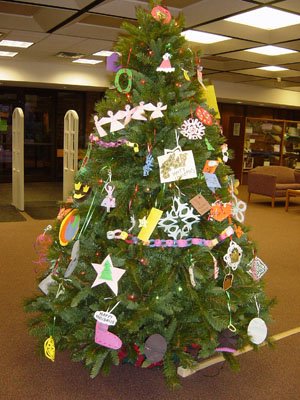
Here's the tree in all its hand-made glory. Photo courtesy of Kathie Martin.
It's hard to believewe're one day away from the end of finals - the library is packed on Monday afternoon with students studying together, hunching over books on the "quiet floor" and working on last-minute papers. Students are checking out books to read over the break (and, by the way, we have another list of new books up on our Web site), and on the main floor there's a hum of conversation as students study together.
But that's nothing new. A Gustavian Weekly editorial from 1960 titled "Chaos Reigns At Library" complained about the popularity of the library. (Thanks to Mike Haeuser for pointing it out.) "At least fifty percent of the scholars go to the library to 'spend the evening,' and a sizeable percentage of the remaining half engage themselves in a few exceptionally long study breaks. The library has thus become a social center, a condition long recognized but which is now being aggravated even further by the increased number of students streaming into the traditionally quiet chambers."
The authors of the editorial recommended action: "In order to halt the chaos which is now reigning at the library, students must either accept a personal responsibility to retain a quiet atmosphere or they must be reprimanded by a policing system, as in high school." Wonder what this critic would have thought about cell phones?
We're happy they stream in, now, and we don't mind a little chaos. Having designated one floor for quiet study appears to have given students the choices they want, while students who need to work together can do so. In fact, if the library were too quiet we'd have to wonder what we were doing wrong.
Have a good holiday and a pleasantly chaotic new year.
Tuesday, December 13, 2005
Shelve Under Ick
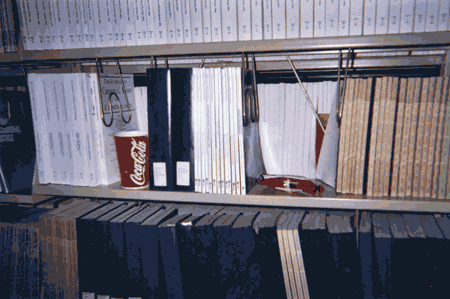
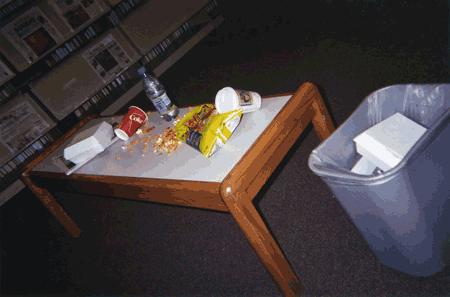
Students who spend hours in the library naturally want to be comfortable, and that means being able to have food and drink handy. We're okay with that. We're not okay with leaving trash around for others to pick up, and we're troubled by the sheer amount of waste involved. The Student Senate and the Gustavus Greens have worked with library staff to encourage students to "Leave No Trace."
Be kind to our hardworking and wonderful custodians. Be kind to your fellow students. Leave no trace.
Public art ... that's our Christmas tree this year. Check out the interesting ornaments created by our students who played with scissors and glue and their imaginations when they needed a break from studying. What an artistic bunch.
Need something to read over the holidays? We have plenty of new books to browse.
Changes afoot. We will be making a few changes to our Website during January thanks to suggestions made during focus groups with students and faculty. But don't worry - we won't be making any major overhauls in mid-year. And any further ideas, thoughts, or wild ideas are always welcome.
Wednesday, November 23, 2005
The Latest from the Library
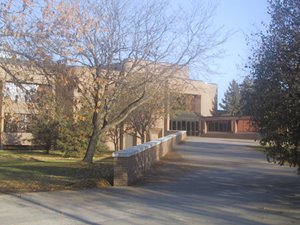 Focus groups of students and faculty have given us much food for thought about our library's Web page. Thanks to Anna Hulseberg and Michelle Twait, as well as to Laura MacPherson and Paul Coleman, the library's Academic Assistants, for taking on this project - and to the students and faculty who participated. We'll be discussing your suggestions at a meeting next week.
More new books can be browsed in our latest acquisitions list.
Jane Kirtley's visit was well attended last Thursday evening. Thanks to faculty who publicized the event to interested students. We may be having one more September Project event this year - a follow-up to the Hurricane Katrina Teach-In. So many of our students are doing service learning in the wake of both Katrina and Wilma we think we'll want to get together and catch up on the issues some time this spring.
If a picture's worth a thousand words, how much for a map? This graphic account of damage to libraries during the Katrina disaster is certainly telling. It's very simple, yet somehow the extent of the damage has much more impact in this cartographic form than a simple list would have.
Speaking of pictures - the photo at the top of this post is one that Stacia Senne took a while ago. Quite nice!
Sidney Verba thought he was coasting toward a peaceful retirement ... but now he's in the center of a controversy. The New York Times has a nice article on this Harvard librarian's reaction to the Google library project. (Can't help adding - what a great surname for a man in his profession!) One of the practical problems with digitization projects - when you don't have Google's deep pockets - is figuring out who to ask for copyright permission. The "orphan works" issue is a real head-scratcher. The Council on Library and Information Resources has produced an interesting report on that problem.
All Things Considered has just considered a Connecticut library's fight against the built-in gag order that comes with PATRIOT Act's National Security Letters. Last Friday a bipartisan group of senators unexpectedly put the brakes on racing to reauthorize the provisions due to sunset at the end of December. Stay tuned ...
Barbara
Tuesday, November 08, 2005
Go Ahead, It's Good For You
 Chill out! Students working in our Interlibrary Loan department had a table at the annual wellness fair. Here they are, proving the point that reading leads to happiness. We're happy they took the initiative to represent the library at this event. Looking for something to read? Check out our latest list of new books.
Jane Kirtley of the Silha Center for the Study of Media Ethics and Law will be here Thursday, November 17th at 7:00 p.m. in the Interpretive Center to speak on "Shooting the Messenger, or Shooting Ourselves in the Foot? Challenges to a Free and Independent Press." Join us for some stimulating conversation - one more event for our September Project events. (She's brilliant, by the way.)
How much is that research in the window? The one with long, long tail. Here's a nifty calculator for what a typical journal article "costs" in reality. Bottom line: scholarly societies provide a better bargain than commercial publishers.
Barbara
Wednesday, October 19, 2005
Focus on the Library
Tell us what you really think. The library will be conducting a focus group this fall to help us evaluate the effectiveness of our website. We would like to invite 5-10 faculty to share their unique perspective on the library and its resources - we would love to hear your thoughts and suggestions. (We will also be talking to students.)
The focus group session will take place in mid-November, on a date based on participants' schedules, and will only require an hour. Lunch will be provided. If interested, please contact Michelle Twait at x7563 or mtwait@gac.edu.
New courses offered by the library include a January term course to be taught by Michelle Twait exploring the information professions (a natural for the January theme of Vocations) and a .5 credit spring course taught by Barbara Fister for students planning on graduate school. Feel free to contact us for more information. Here are the course descriptions:
NDL124: Vocations and Information Professions. (January term, M-F, 1:30-3:30) This course will introduce students to various information professions (museum studies, librarianship, and archival studies, with some consideration of information technology, publishing, and journalism). Students will explore the notion of vocation through a discussion of ethics, social justice, and service in these professions. In addition, through readings, papers, and projects, students will investigate the legal and political issues confronting today's information professional. Students will also have the opportunity to go on site visits, interview information professionals, and design and implement a service project.NDL301: Information Fluency for Graduate Studies. (Spring term, Mondays, 2:30-4:20) This course will give students interested in going to graduate or professional school -- or who simply want to know more about research -- an immersion in the structure of the literature of their chosen field and exposure to research tools and collections. Students will keep a research log and develop an extensive literature review for a research question of their choice. Shorter projects will require students to analyze aspects of their discipline's traditions, to compare them to traditions in other fields, and to explore the social and ethical dimensions of research.
New books keep arriving. Here's our latest list for your virtual browsing pleasure.
Barbara
New courses offered by the library include a January term course to be taught by Michelle Twait exploring the information professions (a natural for the January theme of Vocations) and a .5 credit spring course taught by Barbara Fister for students planning on graduate school. Feel free to contact us for more information. Here are the course descriptions:
NDL124: Vocations and Information Professions. (January term, M-F, 1:30-3:30) This course will introduce students to various information professions (museum studies, librarianship, and archival studies, with some consideration of information technology, publishing, and journalism). Students will explore the notion of vocation through a discussion of ethics, social justice, and service in these professions. In addition, through readings, papers, and projects, students will investigate the legal and political issues confronting today's information professional. Students will also have the opportunity to go on site visits, interview information professionals, and design and implement a service project.NDL301: Information Fluency for Graduate Studies. (Spring term, Mondays, 2:30-4:20) This course will give students interested in going to graduate or professional school -- or who simply want to know more about research -- an immersion in the structure of the literature of their chosen field and exposure to research tools and collections. Students will keep a research log and develop an extensive literature review for a research question of their choice. Shorter projects will require students to analyze aspects of their discipline's traditions, to compare them to traditions in other fields, and to explore the social and ethical dimensions of research.
New books keep arriving. Here's our latest list for your virtual browsing pleasure.
Barbara
Friday, October 14, 2005
ERIC update and more
The ERIC education database underwent some major changes last year as it launched a new Website. It was an improvement, especially in the way full text ERIC documents were linked, but the interface wasn't without its problems. We're now getting it through the Cambridge Scientific Abstracts interface. This allows for better advanced searches, easy interlibrary loan requests, the option of downloading records to RefWorks, and the option of running the same search in multiple CSA databases, such as ERIC with PsycInfo or Physical Education Index. We think you'll like the change.
We've also just added a large package of social sciences journals published by Sage, also through the CSA interface. These electronic journals will be of particular interest to students in Sociology and the Criminal Justice program but there are lots of other subjects included too. They can be found quite seamlessly through a number of databases - and we'll add them to our subject guides as well. We couldn't afford this online resource when we checked it out earlier, but this fall the publisher offered libraries in Minnesota a deal too good to refuse.
Coming soon ... we'll be putting the posters created by FTS students in the "Stories from the Source" class (taught by Eric Eliason and Brian Johnson) on display in the library. Each poster presents a variety of ways in which Biblical stories have been reinterpreted in the arts.
US News has discovered podcasts, back channels and "bookless libraries" at work in higher education. Wow, students can use library materials outside the library! Uh, yes, we'd noticed. We also notice that the library still seems to be a popular place to use those resources. (Hey, you try concentrating on a Critical Inquiry article in a dorm room.) Though we've extended hours to 1 p.m. most nights, we still get lobbied for longer hours.
Barbara
We've also just added a large package of social sciences journals published by Sage, also through the CSA interface. These electronic journals will be of particular interest to students in Sociology and the Criminal Justice program but there are lots of other subjects included too. They can be found quite seamlessly through a number of databases - and we'll add them to our subject guides as well. We couldn't afford this online resource when we checked it out earlier, but this fall the publisher offered libraries in Minnesota a deal too good to refuse.
Coming soon ... we'll be putting the posters created by FTS students in the "Stories from the Source" class (taught by Eric Eliason and Brian Johnson) on display in the library. Each poster presents a variety of ways in which Biblical stories have been reinterpreted in the arts.
US News has discovered podcasts, back channels and "bookless libraries" at work in higher education. Wow, students can use library materials outside the library! Uh, yes, we'd noticed. We also notice that the library still seems to be a popular place to use those resources. (Hey, you try concentrating on a Critical Inquiry article in a dorm room.) Though we've extended hours to 1 p.m. most nights, we still get lobbied for longer hours.
Barbara
Friday, October 07, 2005
new books and book news
Check out our list of new books added to the library in the second half of September. We make these lists available twice a month. It's one way to see what's new - an armchair (or desktop) version of browsing the new books shelf in the comfy area near the front door.
Also in that comfy area you'll find a display for Banned Books Week. Many of the books in this display were challenged in school and public libraries; you're welcome to check any of them out. While you're at it, take a look at the Nobel exhibit, which includes clocks from the collection of Howard and Tami Cohrt. If you have ideas for displays, let us know.
Yahoo is going head to head with Google to digitize library collections - but with a difference. In their "challenge to Google" (as The New York Times puts it) Yahoo is teaming up with libraries and other partners in the Open Content Alliance. The digital archive will be maintained by the Internet Archive. They are avoiding the copyright issue by only digitizing works that are either not under copyright or for which they have permission. For this group, the object is to make works available through open access. Though not an entirely new project (the Internet Archive has been at work on a "million books project" long before Google entered the fray) this enterprise was able to capture attention through a partnership with Yahoo, a major competitor of Google. Meanwhile, publisher Tim O'Reilly chides authors who have sued Google over their library project, arguing that it's in their own self-interest to let Google help readers find their books - a "search and rescue" mission needed to help rescue books from obscurity.
Barbara
Also in that comfy area you'll find a display for Banned Books Week. Many of the books in this display were challenged in school and public libraries; you're welcome to check any of them out. While you're at it, take a look at the Nobel exhibit, which includes clocks from the collection of Howard and Tami Cohrt. If you have ideas for displays, let us know.
Yahoo is going head to head with Google to digitize library collections - but with a difference. In their "challenge to Google" (as The New York Times puts it) Yahoo is teaming up with libraries and other partners in the Open Content Alliance. The digital archive will be maintained by the Internet Archive. They are avoiding the copyright issue by only digitizing works that are either not under copyright or for which they have permission. For this group, the object is to make works available through open access. Though not an entirely new project (the Internet Archive has been at work on a "million books project" long before Google entered the fray) this enterprise was able to capture attention through a partnership with Yahoo, a major competitor of Google. Meanwhile, publisher Tim O'Reilly chides authors who have sued Google over their library project, arguing that it's in their own self-interest to let Google help readers find their books - a "search and rescue" mission needed to help rescue books from obscurity.
Barbara
Sunday, October 02, 2005
Find it!
Our link resolver is working well. You'll find yellow "find it" buttons in most of our online databases that will take you to full text in other databases or to the library catalog. (In many cases, you'll go to the full text article directly, but not in databases such as LexisNexis that don't have persistent links.) Last year, surveys showed students had a hard time knowing how to connect a database reference to a book or article in hand. This fall, the first year students who have been using it seem to be having far less difficulty.
We're still working on the Journal Locator list - currently it only lists online journals, not those that we get in print. (Print journals can be found in the MnPALS catalog or through the Subject Guides.) Thanks to Amy Fry and all the others who have put so many hours in on this project.
Libraries are the subject of a special supplement to The Chronicle of Higher Education (subscription required; it's in the library in print and online through our LexisNexis subscription). Of particular note: a piece by Scott Carlson on the current interest in the library as place. Carlson wrote an article in 2001 that went down in the annals of How to Push Librarians' Buttons - "The Deserted Library." I suspect we all owe him a debt since the outrage he managed to stir up made librarians think hard about what role libraries play in today's wired world and helped them articulate why these places are still important.
Save the date: November 17th at 7 p.m. in the Interpretive Center, come hear Silha Professor of Media Ethics and Law, Jane Kirtley, talk about the climate for media and the exchange of information since 9/11 - part of our September Project activities. She's a fascinating speaker.
Barbara
We're still working on the Journal Locator list - currently it only lists online journals, not those that we get in print. (Print journals can be found in the MnPALS catalog or through the Subject Guides.) Thanks to Amy Fry and all the others who have put so many hours in on this project.
Libraries are the subject of a special supplement to The Chronicle of Higher Education (subscription required; it's in the library in print and online through our LexisNexis subscription). Of particular note: a piece by Scott Carlson on the current interest in the library as place. Carlson wrote an article in 2001 that went down in the annals of How to Push Librarians' Buttons - "The Deserted Library." I suspect we all owe him a debt since the outrage he managed to stir up made librarians think hard about what role libraries play in today's wired world and helped them articulate why these places are still important.
Save the date: November 17th at 7 p.m. in the Interpretive Center, come hear Silha Professor of Media Ethics and Law, Jane Kirtley, talk about the climate for media and the exchange of information since 9/11 - part of our September Project activities. She's a fascinating speaker.
Barbara
Friday, September 09, 2005
September Project news and more
Our participation in The September Project kicks off on Monday, September 12th, with a panel discussion, Perspectives on Civil Liberties in the Post 9/11 World. Faculty from four disciplines will lead a discussion on the tension between security and liberty. Join us on the 1st floor of the library at 7 p.m. for an interesting conversation, and check our Website for more events and links. There are now over 600 libraries in 31 countries participating in this project. The project blog makes for interesting reading, as does a story in the Chronicle. (We, apparently, fall into the category of libraries that "have decided to take on charged subjects." It seems to us citizenship does carry a charge - in multiple senses of the word.)
Lots of new faces in the library! In addition to Sonja Timmerman who joined us this summer as Collection Manager, Amy Fry has joined us as an academic librarian and Sarah Sanford has come aboard as our new Serials Manager. (Some of you may know her from her days as a Gustavus student.) And one more staff addition: Shelley Grace is pitching in at the reference desk this fall. Come and say hello when you get a chance.
The Lutheran Church Archives, under Edi Thorstensson's leadership, has submitted 18 historical photographs to the Minnesota Digital Library Coalition's first project, Minnesota Reflections. This project, involving more than 50 libraries, historical societies and archives, offers free access to more than 6,000 images from Minnesota's first 50 years in a searchable database. For more information, contact Edi Thorstensson.
The GLA wants you! Our stellar Friends group, Gustavus Library Associates, is having a membership tea at the Interpretive Center at 10 a.m. on Monday, September 12th. All membership dollars go straight into book purchases.
Barbara
Lots of new faces in the library! In addition to Sonja Timmerman who joined us this summer as Collection Manager, Amy Fry has joined us as an academic librarian and Sarah Sanford has come aboard as our new Serials Manager. (Some of you may know her from her days as a Gustavus student.) And one more staff addition: Shelley Grace is pitching in at the reference desk this fall. Come and say hello when you get a chance.
The Lutheran Church Archives, under Edi Thorstensson's leadership, has submitted 18 historical photographs to the Minnesota Digital Library Coalition's first project, Minnesota Reflections. This project, involving more than 50 libraries, historical societies and archives, offers free access to more than 6,000 images from Minnesota's first 50 years in a searchable database. For more information, contact Edi Thorstensson.
The GLA wants you! Our stellar Friends group, Gustavus Library Associates, is having a membership tea at the Interpretive Center at 10 a.m. on Monday, September 12th. All membership dollars go straight into book purchases.
Barbara
Thursday, August 25, 2005
the plot thickens
Either-Or?
Some of you will have discovered we've made a change in off-campus access to our databases. Now, rather than making changes in your browser settings, you can access databases through any browser without having to go under the hood. The drawback? Each time you start a search you have to enter your barcode (from your Gustavus ID) and last name. So long as you're searching, it will recognize you no matter how many databases you access. But once you close your browser window it has amnesia and makes you reenter that long string of numbers. For the occasional searcher, this change will probably make life easier, but for those of us who prefer to do our research at home it's going to be more work. Unfortunately, there's no way to provide both options.
Or-Either?
The Christian Science Monitor has a piece on the University of Texas's decision to move 90,000 books from their Undergraduate Library and replace them with computers. There is always a Sophie's Choice tone to these pieces - what's it gonna be, books or computers? Scott Carlson's famous "Deserted Libraries" story sparked a lot of controversy when it was first published in 2001, but it's the headline that sets off the alarms. In reality, the piece presents a range of issues and talks about libraries that are anything but deserted.
Both stories are about a changing perception of the library as place. Scott Bennett's report on libraries as learning commons shifts the focus from either/or to both and from information to learning. And that makes a lot of sense.
Barbara
Friday, August 19, 2005
check it out
We're in the process of changing all the URLs for electronic resources on our Web pages over to fit our new proxy server (so that you can search from home without having to fool around with your browser). It may take a little while to catch them all. You can always let us know if you find one that isn't working.
In the news, a British paper weighs in on Google's library digitization project. They think an argument can be made for it being not only a good idea, but actually legal. Meanwhile, the American Bar Association seems a tad amazed to learn that librarians can be a little pushy when they have a principle to defend.
And here's a Swedish library with a personal touch: want to find out more about the issues? check out a person at your local library.
Barbara
In the news, a British paper weighs in on Google's library digitization project. They think an argument can be made for it being not only a good idea, but actually legal. Meanwhile, the American Bar Association seems a tad amazed to learn that librarians can be a little pushy when they have a principle to defend.
And here's a Swedish library with a personal touch: want to find out more about the issues? check out a person at your local library.
Barbara
Monday, August 15, 2005
can you spare some change?
This Friday, August 19th, we're switching over from one form of off-campus authentication to another. What on earth does that mean? Well, if you've set up your browser to recognize you as an authentic Gustie for the purposes of searching our databases, you can turn it off now. The system will know who you are without fiddling with your browser at all. (Of course, that means if you already fiddled, you'll need to unfiddle. Depending on what browser you use, it's just a matter of clicking a choice in your preferences.) This should make it easier for all of us--students included--to use library resources from off campus. That takes care of one more "dog ate my homework" excuse.
Another project in the works: we are setting up a system to link directly to full text articles in one database from a citation in another (or even, eventually, from Google Scholar). We've found that actually finding the articles that are listed in a database is a huge challenge for many of our students, so we hope this will help.
Of course, libraries aren't the only ones adapting to changing expectations. Publishers, according to The New York Times, are introducing paperbacks that offer more readable pages for an aging audience. They'll be the same width, to fit on bookseller's racks, but they'll be taller. The price will be a bit steeper, too.
Google has backed away from its ambitious plan to digitize libraries - sort of. They're giving publishers an opportunity to opt out. Publishers (at least some of them) are not convinced that making a copy and showing the public snippits is within fair use. This is another example of how the concept of "copy" in a digital world is making it harder than ever to know what's legal. Many lawyers love the Internet Archive's "Wayback Machine;" they can find that embarrassing comment you thought you'd deleted from your site. But naturally, at least some folks suggest the archive itself violates copyright law. The jury is out ...
Another project in the works: we are setting up a system to link directly to full text articles in one database from a citation in another (or even, eventually, from Google Scholar). We've found that actually finding the articles that are listed in a database is a huge challenge for many of our students, so we hope this will help.
Of course, libraries aren't the only ones adapting to changing expectations. Publishers, according to The New York Times, are introducing paperbacks that offer more readable pages for an aging audience. They'll be the same width, to fit on bookseller's racks, but they'll be taller. The price will be a bit steeper, too.
Google has backed away from its ambitious plan to digitize libraries - sort of. They're giving publishers an opportunity to opt out. Publishers (at least some of them) are not convinced that making a copy and showing the public snippits is within fair use. This is another example of how the concept of "copy" in a digital world is making it harder than ever to know what's legal. Many lawyers love the Internet Archive's "Wayback Machine;" they can find that embarrassing comment you thought you'd deleted from your site. But naturally, at least some folks suggest the archive itself violates copyright law. The jury is out ...
Thursday, June 30, 2005
database changes
You'll notice some changes on our Webpage. Two databases - Women Writers Online and the AMICO art database are disappearing. We will be investigating alternatives to AMICO, a museum consortium that has been merged into something called ARTSTOR that is less attractive to us.
We will also temporarily lose our handy-dandy Journal Locator list as we switch to a different product. If you need to know whether we have a journal online or in paper, give the library a call since we have a print copy. You can always find print journals cataloged in MnPALS - it's the myriad of online subscriptions that are tricky to track down.
One last change: PAIS (the venerable Public Affairs Information Service database) is moving to a new interface. We think you'll like it.
Barbara
We will also temporarily lose our handy-dandy Journal Locator list as we switch to a different product. If you need to know whether we have a journal online or in paper, give the library a call since we have a print copy. You can always find print journals cataloged in MnPALS - it's the myriad of online subscriptions that are tricky to track down.
One last change: PAIS (the venerable Public Affairs Information Service database) is moving to a new interface. We think you'll like it.
Barbara
Subscribe to:
Posts (Atom)